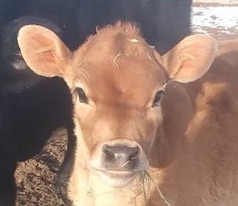
The price of milk

I enjoy milking my cow. It’s very intimate sitting on my bucket, leaning my head against her massive side. I listen to her snuffle through the hay for the best bite, hear and feel her side-to-side chewing and then the great swallow. Her teats are warm and soft in my hands, leathery like I imagine elephant skin. The milk jets into the bucket, full of promise. I imagine I feel contentment rolling off her as she eats her breakfast and gets some relief of pressure with my gentle milking, so much less boisterous than the determined nursing of her calf that comes next.

Now there’s fresh milk in my kitchen. A lot of it. I’ve learned how to make yogurt, ice cream, butter, cottage cheese, hard cheese. Every milky thing we can dream of we have. It’s clean and rich and hasn’t given us a moment of discomfort or concern.

My cow is sweet, the milk is sweet. It’s a lovely cycle.

So how do I reconcile the other side of this exchange? To keep in good milk, our cow has a calf every year. The traditional thing to do is butcher these calves after 12-18 months. A calf born, a calf killed, every year.

On a small spread like ours, you get up close and personal with the animals, the way I like it. By the time our current calves reach butchering age, I will have logged thousands of hours with them. Watching over their health, halter training them, scratching their heads, enjoying their playtime, observing their developing minds and bodies. And then I’m supposed to preside over their deaths.

The justifications are many:

  • These calves will have the best possible 18 months of life and the easiest deaths we can provide
  • As long as we consume any dairy products, we’re participating in this cycle, and it’s ethically cleaner to face up to it directly
  • By raising our own milk and meat and sharing it with several families, we are reducing the demand for the services of confined animal feeding operations, hellish places on many levels

Mama cow is grazing contentedly in the meadow. The calves pretend to eat grass, kick up their heels and run in aimless circles, butt their heads together, and return to mama’s side. The milk is sweet, the calves have 16 more months to live.

The justifications are many, and the heartache has yet to be plumbed.

Reasons to Burn

One day, I decided maybe I could burn at the stake, after all. Before that day, I thought, “there is no belief that I hold so dearly that I would allow myself to be burned at the stake rather than forsake it.” According to Wikipedia, when Joan of Arc was burnt alive, her last words were “Jesus, Jesus, Jesus!” Now that’s fidelity to a belief. It was a relief to think I could burn, too.

It’s sad to have such paltry beliefs that they could not survive the mere threat of burning alive. Yet, over the years, under attack from innumerable opinions and theories lobbed at me from friend and foe alike, some solid beliefs have lodged in me. “No,” I can say, “I cannot agree with that, because I believe something else and I will not be shifted.” Tie me up and bring the oil, I’m ready! I believe two things!

#1.  Nature has it right.  The web of biological, physical, chemical, quantum, and mathematical powers is perfect. More than perfect, it’s unceasingly mind-blowing. Stable and independent orbits of numerous bodies around a central star.  Giant Tubeworms that survive without sun or oxygen, 5,000 feet below the sea’s surface.  Tardigrades that can survive the vacuum of space and incorporate other beings’ DNA into their own. DNA.  The brilliance of the Jack Pine cone that only drops its seeds after a fire that clears the ground for their germination.  The structure of the inner ear. 

Nature has lots of rules. Things that happen so universally that they are, de facto, rules. Here are just a few: You’re born, you grow, you age, you die.  Entropy happens. Everything is made out of something else that already existed.  Things come (and go) in cycles. 

Here are a few more: There’s no such thing as eternal growth.  You can’t consume more than you need for very long.  Over-crowding is not tolerated.  There is no top of the heap – the bacteria will get you eventually.  You can make a tree into a house or a tiger into a rug, but there are limits – taking atoms apart has grave consequences.

Nature doesn’t screw around. You can’t break the rules, it’s not possible. And if you try to, really work at it, you’ll most likely die.

I believe in nature.  I can go to the fire shouting “The laws of nature! The laws of nature!” Hooray!

#2.  It’s all gray area. There are (almost) no absolutes. Outside the laws of nature, that is. Usually. 

People who are certain of things all the time bother me. First, it’s boring.  Absolutists have no imagination and no curiosity and that is very dull.  Second, it’s demonstrably false.  Show me most absolutes and I’ll find you some exceptions. Third, it’s lazy.  Absolutes take no effort, no thought. Remaining open to all possibilities and casting around for nuance takes more time. Fourth, it ends all conversation. There is no answer to an absolute except (1) another absolute (i.e., a fight); or (2) a meaningless acknowledgment (“mmmmm” or “oh?”). Back to boring, and downright rude in settings where conversation is the intent

Can I go to the stake shouting “Maybe! Sometimes!”? A martyr to uncertainty?

But what if I already professed absolute belief in the laws of nature? Hopefully I would only be called on to die for one belief at a time, because they kind of cancel each other out. Now I’m just confused again.