Heading beyond good and bad

IMG_1073

I was thinking about horses today, which I guess goes without saying.  Yesterday my young horse Bridger was a turd during our ride and today he was charming.  That’s what I said to a friend, only it’s not true.  On both days he was himself, doing what he needed to do.  The rest is on me.

I called my trainer Kathleen to complain about his fractious behavior yesterday.  As always, she was consistent in using words like “lost” and “troubled,” while I was thinking “shit head” and “obnoxious.”  This, even though I love my horse to distraction and always fall into sentiment where he’s concerned.  Even still, Kathleen has to remind me over and over and over again to look at the world through his eyes instead of rushing to label him.  I know how to do this; I believe this is the right thing to do; I enjoy doing this; but I always forget to do it when things get tough.  I keep defaulting to blaming my horse.

Yesterday I took Bridger on what was supposed to be a short, easy, mindless ride on the road past our house.  It was late afternoon at the end of a long and tiring work week and I thought this little outing would be just the thing.  Instead, Bridger was tossing his head and surging forward, threatening to bolt out from under me.  When I picked up a rein to ask him to turn his head, he grabbed the bit with his mouth and pulled the other way.   At one point, he thought he might rear up on me, which he hasn’t tried for almost a year.  His body thrummed with energy.  We were on the edge of a blowup most of the time.  Using everything Kathleen taught me over the years, I kept a lid on things.  Instead of heading down the road, we spent 45 minutes circling and slaloming and backing and retracing our steps over 30 yards of road and shoulder.  When I finally got him to cooperate with me a bit, I jumped off and called it a frustrating day.

I managed to make the worst of it, as I often do.  Why was he such an ass?  I asked myself.  I’m really screwing this horse up, I told myself.  I’m allowing him to be a spoiled jerk, I complained, and we are both going to hell in a hand basket.  I called Kathleen.  Did I do the wrong things with him?  Should I have done this instead of that?  Maybe, she replied, but most importantly, she spoke for Bridger.

What I saw as an easy little outing was actually one of the tougher things I could have asked of him.  I took him away from his friends to ride alone, which is always challenging for an inexperienced horse.  But I didn’t take him far — he could hear and smell and see his buddies the whole time.  I set up a situation in which he was sure to be both worried about being alone and highly motivated to get back to the friends who were so tantalizingly near.  We reminisced that when we took Bridger away from home with no other horse in sight he usually did just fine.  He’s not awfully worried about simply being away from his friends, but I put him in a double bind and then expected him to focus and relax.  And let’s not forget that I was probably tired and strung out, which did nothing to ease his concerns.

Instead of seeing what he was going through, I called him a shit head.  Thank goodness I’m well-trained enough that I didn’t punish him or yell at him, but I labelled him bad and savaged myself for making him bad.

Isn’t this what we do?  You’d be amazed how many horses are stupid shit heads every day, running or bucking or otherwise trying to save themselves from things we don’t take the time to understand.  Things we create for them, as often as not, and then blame them for their reactions.

Today I took Bridger to the arena along with his buddy Jack.  I let him run and buck a little first and take a couple rolls in the hot sand.  Then we did some work while Jack stood nearby.  Bridger was an excellent student today, and a wonderful guy to be around.  If I were less educated, I might congratulate myself on having a perfect horse and being an especially skilled horsewoman.  That’s a more pleasant picture than yesterday’s, but it’s no more true.

On both days, my choices and the environment created circumstances.  I came to both situations with expectations and a background emotional state.  Bridger responded to the circumstances and to me as it all seemed to him.  Today his responses fit very nicely with my plans.  Yesterday, not so much.  End of story.


The Om in Horsemanship


Om

It’s pouring down rain, so there won’t be much horsing around today.  My goal of riding Bridger every day as a cure for our woes is on pause this day.  But there’s plenty of time for thinking about horses and life and stuff.

Horseman Peter Campbell says something like “the problem is not the problem, your attitude about the problem is the problem.”

My “problem” with Bridger is very simple — there are things he needs to understand better and ideas he has that I’d rather he didn’t.  This wouldn’t be a problem at all except that the process of teaching and redirecting him can be scary because I sit on his back and he is large and powerful.

But even so, it’s my attitude that creates the problem.  When Bridger gets fractious or lost, there are a couple options.  If I were Buck Brannaman, I’d ride him right through it without blinking because I would know I could.  Or, I could see the issue developing, mindfully dismount and address it from the ground.  Neither is a problem.

What do I do?  Fear grabs me, or maybe frustration, and right behind come self-doubt, self-criticism, dismay and a bunch of other complicated emotions.  My muscles tighten, my mind trips offline.  I’m lost in a feeling storm, useless for giving my horse the direction and confidence he needs.  If I’m not careful, I can start blaming Bridger for the whole mess.  And voila — a real problem.

FDR would have answered Peter Campbell nicely, adding, for example, that all we have to fear is fear itself.  Or anger or jealousy or despair.  My yoga teachers would nod sagely — notice where your mind goes when your body is challenged, they say, is it necessary?

How many times a day do we create problems with our emotions and reactions where, in fact, there is simply a circumstance?

Yoga and horsemanship point me in the same direction: stick with exactly what is for a while and let the rest go.  Next time I get on Bridger’s back, I’ll be really trying to do just that.

Going Steady with Fear

I rode Bridger today.  You’ll understand something about that if you read this earlier post.  It means a lot.

Last summer, Bridger and I hit a big glitch in our progress.  I asked him for a little more than he was ready for, so he gave out a little buck, which was enough to unseat me, which was enough to crack my ulna.  Neither the buck nor the crack were such a big deal.  The killer was the fear that immediately colonized me.

Fear has not been a big thing with me.  Not on a conscious level, anyway.  I’ve had plenty of dicey moments on mountain bikes, on snow-covered slopes in the backcountry, with lightning on the alpine tundra, in class 4 river rapids after I fell out of the boat.  I’ve unexpectedly come much too close to male moose and grizzly bear cubs.  Each event had its adrenaline-soaked excitement and some hindsight shivers, but each easily became a great story to revisit over a beer.  Not so with my fall off Bridger.

I am inherently, helplessly scared of heights. I grow dizzy and watery too close to a precipitous fall.  I feel compelled to go over — if someone forced me to spend too long on a tiny ledge, I might have to plunge over.  So I do have that fear, but I handle it by simply avoiding the situation.  I tried rock climbing, which would have been a good match for my other mountain hobbies, but there wasn’t enough in it to overcome the visceral fear, so I left it behind.  I admire views from a safe distance.  I can’t leave Bridger behind or stay at a distance.

After my fall off Bridger, pictures of people riding horses made me queasy.  Being around my horses at feeding time gave me all-over prickles.  After my arm healed a little, I got on my older horse, Jack, who is as reliable, slow and calm as they come.  I felt sick and loose-limbed.  I shed tears.

I mostly got over it.  With the superb help of friends, a couple sports psychology books and patient Jack, it eased up and left me.  Meanwhile, Kathleen was busy helping Bridger get over his own problem.  Six months after the fall, I was riding Bridger in the backcountry on an unfamiliar trail, having a good time.

This year, we hit another glitch, but on a smaller scale.  You can learn more about that here.

Again, I backed up and brought Kathleen in.  Again, it got better after only a few weeks of focused effort.

So today, I went out by myself and rode Bridger.  I fought back butterflies before I got out to the corral.  I talked out loud to myself when he wiggled his head and slewed his ribs the wrong way and acted like there was a mountain lion in the bush.  It worked out pretty well, but I think I have begun a long-term relationship with fear.  For (maybe) the first time, I have a thing, and a family member, that cannot be denied or left behind and that evoke a new kind of fear.  I’m very happy I got myself out there and had a nice little ride today, but there is much more to understand.


This Horse Ain’t Broke

They used to call it breaking a horse.  Many still do.  Breaking his spirit, breaking his independence.  Taking something correct and complete and destroying it.  It’s fitting terminology for what it used to look like (and still does in some circles).

                 I was going to insert a video clip of a horse getting “broke” here but I just can’t do it, so here’s something cute instead:

201110 baby
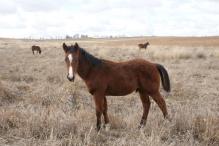
My colt Bridger at four months, correct and complete

I broke my arm once.  Just a little, hairline fracture.  It’s healed up now, but it will never be the same.  It can never be unbroken.

The horsemen I follow call it starting a horse.  Starting into a long education.

<Buck Brannaman explains how it’s supposed to be>

We ask the horse to consent to do what we ask.  We give him time and space to consider his options, and in the end, he usually agrees with our suggestions.  It’s a wondrous thing.

But what about when he doesn’t?  In his fifth year, Bridger suddenly started disagreeing.  Suddenly, that is, if one has failed to see the ripples and eddies forming on the surface of the pond.  Bridger has now decided to revolt against those things he doesn’t like.  The sweet, seemingly compliant kid has erupted into a surly teenager.

He’s a horse, surly is the wrong word.  He’s unconfident and worried and irritated and frustrated, by turns or all at once.  Maybe he wasn’t before, or maybe he just wasn’t showing it much.  Now he is.  His modus operandi is to rear up, which can be extremely dangerous.


rearing
This is not Bridger and me.  This horse is about to fall over backwards on that person, which could be the end for both of them.  I hope it wasn’t.

So now we have to convince Bridger to quit it.  We have to make him understand that his rearing idea — and his defiance ideas in general — won’t work out for him and he needs to find other ideas.

The plan, implemented by my teacher, Kathleen Sullivan, is to provoke the unwanted response and then show Bridger it’s not in his best interest.  If we pussyfoot around and avoid the tough spot, it will stay in there and solidify.

“If it is repressed and isolated from consciousness, it never gets corrected.”  Carl Jung.

Here’s the thing: correcting a problem can look awfully like breaking something.  Kathleen gets pretty vigorous with Bridger when he thinks about rearing up.  In my work with him, it can be the same.  Dust flies, there is sweat.  First he is quick and powerful and troubled, then, soon, he is docile.

I have to find the difference because I know we are not breaking him and won’t break him and can’t break him.  Right?

Here’s the best I can do so far:

  • Breaking: you reach for my french fries and I punch you in the face.  I have my fries and you resent and fear me.  Someday you may punch me back, if I ever see you again.
  • Correcting: you reach for my french fries and I block your hand; you reach harder and I block harder; I block as fast and hard as I need to in protecting my fries; our hands fly like a Three Stooges routine; you give up trying.  I have my fries and you recognize you won’t get any by grabbing.  Maybe you ask politely and I give you some.  Maybe you order your own.  We’re friends.

Sometimes I use the shorthand term “broke” because horse people understand it.  I tell people Bridger’s “broke to tie” or “green broke.”  I hope beyond hope I haven’t broken anything much.  It’s not the plan.


What I Could Get Done Today

IMG_0242

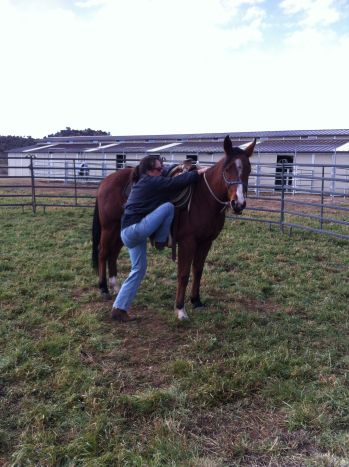
I woke up at 2:30 a.m. in a clammy sweat, wondering if I have what it takes.  I have a young horse, about half-broke, who needs many hours of careful, confident riding to get to a steady state.  Between here and there, he may need to test the limits, maybe bucking with me, or rearing, or bolting.  We’ve done everything to help prevent that, but I’m 52 years old and not much more than a novice rider.  His need to test could be my undoing.

But I can’t leave him as he is; he could be a danger to himself and others.  I need to see this through, but I don’t know if I can.

I’m not alone in this, I have an excellent teacher on board.  She’s sharing the riding job with me and coaching me throughout.  But there’s an interface between the horse and me where only the two of us can go.  That is where we have to forge this relationship, just us.

The stakes are high.  Every day, we are building the house we will live in together from here on out.  It needs to be right.  Every day, there is some risk that I could be hurt, and I have less leeway for that kind of thing than I used to.  If I push myself too hard, I could implode with reactive fear and aversion.  If I don’t push us both hard enough, we could solidify in a half-baked, uneasy mediocrity.

My teacher points out how much I will learn from working through this.  About horsemanship, about my own limits.  She suggests that, when we succeed (as she has no doubt we will), I will enjoy a relationship and a sense of confidence like no other.  Ten years ago, that would have been enough.  Today, in the early hours before dawn, I wonder if I can learn these things anymore.  If I want to.

The mountain is too high to take in the whole.  Today, after we all had breakfast, I took the horse out and worked with him from the ground.  As I walked and stood alongside him, we practiced paying attention even when he was nervous about rustling bushes.  We practiced responding lightly to subtle moves of the reins.  We practiced fancy footwork on challenging terrain.  I put a penny in the jar, saving toward a well-educated horse.  That’s about all I could do today, and about all I had to.