The thing that is not fear but somewhat like it begins to go

index

Here are a few things I’ve learned about fear.*

  • In a two year period: I sat with my father while he prepared to die and at the very moment that he did; I slipped over the brink of menopause; I lost my job and got no calls; I fell off my colt and broke my arm; and I tore myself from my beloved home.  From this recipe, or one like it, in mysterious proportion, fear may be conceived.
  • Fear sneaks in and sets up in your spare room.  You can hint that it’s not welcome, you can put away the breakfast things just as it appears of a morning, you can yell and threaten and throw its things outside, but it doesn’t care.
  • It smells like metal.
  • It makes you clumsy, it saps your competence.  With fear there, you are forgetful, stupid.
  • Fear whispers incessantly about the past and the future, especially the future.
  • It weighs you down and also prevents your feet from planting on the earth.
  • It ruins everything.
  • Fear comes close to winning by sheer, tedious ubiquity.
  • But if you try very hard, and you put on clean clothes, and you keep going outside, and you are civil to fear, and you don’t listen to it much, one day it forgets to wake up before you.  You find you are outside and getting on your horse before fear gets out of bed.  You think first of what might be done instead of what could happen.  You start to remember about joy, you are interested.  Fear looks shrunken, a little grey.  You tell it to go to its room and it does.  This is very good.

*I have no right to say any of this.  I live in a first world setting, lounging in the top 10% of income earners, in robust good health.  I don’t know what it means to live in threat.  Maybe I need a new word here, for the existential, self-regarding kind of overwhelming timidity I’ve been host to.  I don’t know what that word would be, my creativity fails me.  Please imagine I came up with a word other than fear and used it here, so that those who truly know fear can keep that word and be the ones who know what it is, while I admit that I don’t.

Heading beyond good and bad

IMG_1073

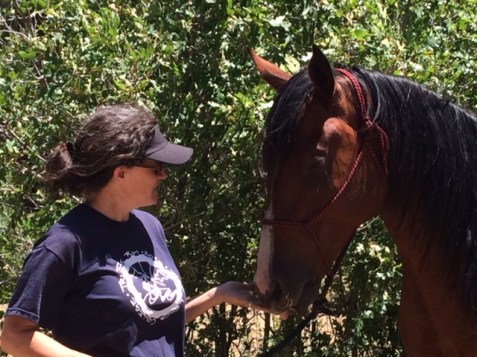
I was thinking about horses today, which I guess goes without saying.  Yesterday my young horse Bridger was a turd during our ride and today he was charming.  That’s what I said to a friend, only it’s not true.  On both days he was himself, doing what he needed to do.  The rest is on me.

I called my trainer Kathleen to complain about his fractious behavior yesterday.  As always, she was consistent in using words like “lost” and “troubled,” while I was thinking “shit head” and “obnoxious.”  This, even though I love my horse to distraction and always fall into sentiment where he’s concerned.  Even still, Kathleen has to remind me over and over and over again to look at the world through his eyes instead of rushing to label him.  I know how to do this; I believe this is the right thing to do; I enjoy doing this; but I always forget to do it when things get tough.  I keep defaulting to blaming my horse.

Yesterday I took Bridger on what was supposed to be a short, easy, mindless ride on the road past our house.  It was late afternoon at the end of a long and tiring work week and I thought this little outing would be just the thing.  Instead, Bridger was tossing his head and surging forward, threatening to bolt out from under me.  When I picked up a rein to ask him to turn his head, he grabbed the bit with his mouth and pulled the other way.   At one point, he thought he might rear up on me, which he hasn’t tried for almost a year.  His body thrummed with energy.  We were on the edge of a blowup most of the time.  Using everything Kathleen taught me over the years, I kept a lid on things.  Instead of heading down the road, we spent 45 minutes circling and slaloming and backing and retracing our steps over 30 yards of road and shoulder.  When I finally got him to cooperate with me a bit, I jumped off and called it a frustrating day.

I managed to make the worst of it, as I often do.  Why was he such an ass?  I asked myself.  I’m really screwing this horse up, I told myself.  I’m allowing him to be a spoiled jerk, I complained, and we are both going to hell in a hand basket.  I called Kathleen.  Did I do the wrong things with him?  Should I have done this instead of that?  Maybe, she replied, but most importantly, she spoke for Bridger.

What I saw as an easy little outing was actually one of the tougher things I could have asked of him.  I took him away from his friends to ride alone, which is always challenging for an inexperienced horse.  But I didn’t take him far — he could hear and smell and see his buddies the whole time.  I set up a situation in which he was sure to be both worried about being alone and highly motivated to get back to the friends who were so tantalizingly near.  We reminisced that when we took Bridger away from home with no other horse in sight he usually did just fine.  He’s not awfully worried about simply being away from his friends, but I put him in a double bind and then expected him to focus and relax.  And let’s not forget that I was probably tired and strung out, which did nothing to ease his concerns.

Instead of seeing what he was going through, I called him a shit head.  Thank goodness I’m well-trained enough that I didn’t punish him or yell at him, but I labelled him bad and savaged myself for making him bad.

Isn’t this what we do?  You’d be amazed how many horses are stupid shit heads every day, running or bucking or otherwise trying to save themselves from things we don’t take the time to understand.  Things we create for them, as often as not, and then blame them for their reactions.

Today I took Bridger to the arena along with his buddy Jack.  I let him run and buck a little first and take a couple rolls in the hot sand.  Then we did some work while Jack stood nearby.  Bridger was an excellent student today, and a wonderful guy to be around.  If I were less educated, I might congratulate myself on having a perfect horse and being an especially skilled horsewoman.  That’s a more pleasant picture than yesterday’s, but it’s no more true.

On both days, my choices and the environment created circumstances.  I came to both situations with expectations and a background emotional state.  Bridger responded to the circumstances and to me as it all seemed to him.  Today his responses fit very nicely with my plans.  Yesterday, not so much.  End of story.


Dislocation

ponderosas


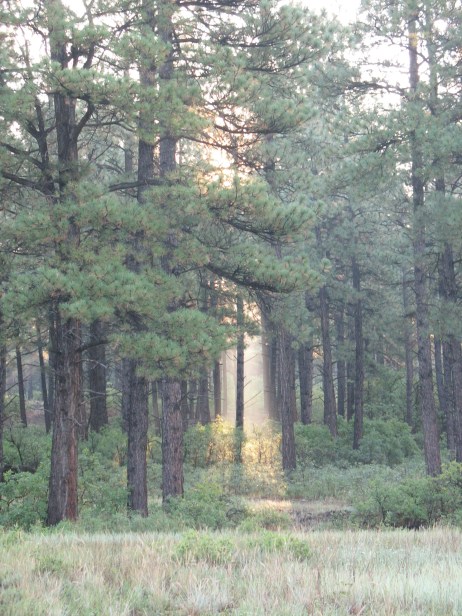
I am dislocated.  As from the medieval Latin, I have been moved from my proper place and position, my normal arrangement has been disturbed.  Synonymously, I have been disrupted, thrown into disarray, disorganized and confused.  These things have happened to me, my passive voice little more than flotsam on a strange sea.

We left our home.  The land we lived on for 11 years, the home we built and finished into contentment.  The place our animals have known as home for all or most of their lives.  It’s simple, really: we couldn’t find adequate jobs in the rural area we lived in, but we found good ones in the urban area we left over a decade ago.  So we did what so many do every day: we moved to find professional opportunity.

But that is the end of simplicity.  Moving is a nightmare.  Moving is stressful and exhausting and painful.  It’s certainly harder with livestock and ranch equipment as part of the mix.  So there’s that.

But this is about something else.  I knew it would be hard work to move.  I didn’t know it would pull my heart through my chest wall and leave it thrashing on the ground like a trout yanked from its stream.

I didn’t appreciate how passionately in love I am with our home.  I didn’t know the lining of my intestines would hum and surge in longing for the particular sound of the breeze in my pines.  I didn’t know my lungs would collapse every time I thought of the view out my living room window.  I didn’t realize my skin would recoil from the foreign air, the wrong wind currents, the landscape that is not mine.

Decades ago, I saw an arthouse movie about an indigenous man in an arctic setting who was captured and put in a jail cell.  It was his first sojourn in a solid structure and the first time in his long life he could not see the sky.  He immediately began to die.  I don’t remember the name of the movie or what happened to him, but I think of him.  Of what happens when you are suddenly stripped of the environment that held you.

I’ve never lived at any one address for 11 years, other than my childhood home.  I’ve never pitched my back and my heart into a place like we did in building our homestead.  I’ve never designed a house and then seen it emerge raw and ready for tending like a greasy newborn.  I’ve never spent my hours and days in the company of the same trees, a revolving but familiar cast of wild animals, and a reliable splash of brilliant stars for 11 years straight.  I didn’t realize what had happened.

I am of that place and that place is of me.  I wrote an essay not long ago, called In the Company of Trees, in which I mused on the reasons for the strange but tangible affinity I felt for my immediate natural environment.  I wrote that my body and the trees around me contain the same top five elements, giving us a kinship not apparent on the surface.  I wrote about my shedding a skin cell, which disintegrated and gave up its prime elements to the tree’s roots, while I breathed in its pollen and oxygen and particles of bark.  Over time, our bodies leaned toward each other.

Torn away, I am bereft.  Sick and empty in the middle.  I don’t think I’ll die of it, but I can see how it’s possible.  I can now understand the desperation of people pushed or ripped from their ancestral homes.  The anguish of thousands of refugees who are so much more dislocated than I, in such dire circumstances.  The land we love is another organ, the loss of which can lead to internal hemorrhage.

Over time, the pain will subside.  The connection will grow distant.  I will mingle my atoms with other places.  That fact in itself makes my chest clench.  Something that can be gotten over diminishes in importance.  I don’t want to get over it.

I will not change the name of my blog because in every important sense, I am still on Elk Meadow Road.  Husband and I will institute a new Thanksgiving-time toast: next year on Elk Meadow Road!  In the meantime, I keep Elk Meadow Road just as I cradle my liver.  I will slowly shed the atoms I picked up from my trees, scattering them in this new environment, but I vow to keep what I became there.


Going Steady with Fear

I rode Bridger today.  You’ll understand something about that if you read this earlier post.  It means a lot.

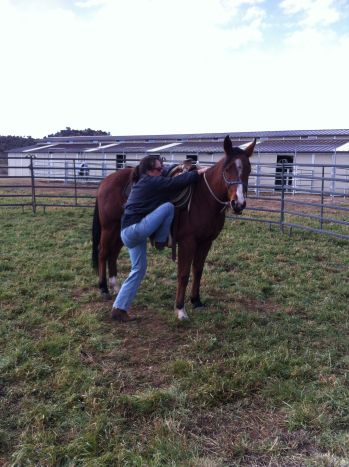
Last summer, Bridger and I hit a big glitch in our progress.  I asked him for a little more than he was ready for, so he gave out a little buck, which was enough to unseat me, which was enough to crack my ulna.  Neither the buck nor the crack were such a big deal.  The killer was the fear that immediately colonized me.

Fear has not been a big thing with me.  Not on a conscious level, anyway.  I’ve had plenty of dicey moments on mountain bikes, on snow-covered slopes in the backcountry, with lightning on the alpine tundra, in class 4 river rapids after I fell out of the boat.  I’ve unexpectedly come much too close to male moose and grizzly bear cubs.  Each event had its adrenaline-soaked excitement and some hindsight shivers, but each easily became a great story to revisit over a beer.  Not so with my fall off Bridger.

I am inherently, helplessly scared of heights. I grow dizzy and watery too close to a precipitous fall.  I feel compelled to go over — if someone forced me to spend too long on a tiny ledge, I might have to plunge over.  So I do have that fear, but I handle it by simply avoiding the situation.  I tried rock climbing, which would have been a good match for my other mountain hobbies, but there wasn’t enough in it to overcome the visceral fear, so I left it behind.  I admire views from a safe distance.  I can’t leave Bridger behind or stay at a distance.

After my fall off Bridger, pictures of people riding horses made me queasy.  Being around my horses at feeding time gave me all-over prickles.  After my arm healed a little, I got on my older horse, Jack, who is as reliable, slow and calm as they come.  I felt sick and loose-limbed.  I shed tears.

I mostly got over it.  With the superb help of friends, a couple sports psychology books and patient Jack, it eased up and left me.  Meanwhile, Kathleen was busy helping Bridger get over his own problem.  Six months after the fall, I was riding Bridger in the backcountry on an unfamiliar trail, having a good time.

This year, we hit another glitch, but on a smaller scale.  You can learn more about that here.

Again, I backed up and brought Kathleen in.  Again, it got better after only a few weeks of focused effort.

So today, I went out by myself and rode Bridger.  I fought back butterflies before I got out to the corral.  I talked out loud to myself when he wiggled his head and slewed his ribs the wrong way and acted like there was a mountain lion in the bush.  It worked out pretty well, but I think I have begun a long-term relationship with fear.  For (maybe) the first time, I have a thing, and a family member, that cannot be denied or left behind and that evoke a new kind of fear.  I’m very happy I got myself out there and had a nice little ride today, but there is much more to understand.


Quiet afternoon in the life of a nascent writer

love-books-1

Re-reading and tweaking the latest draft essay; reading Reading Like a Writer; reading other people’s essays and blog posts; reading one of Jane Goodall’s books because I may be writing about her soon; listening to a podcast interview with a poet I’ve read; wondering why I’m doing any of it; happy as a clam.


What I Could Get Done Today

IMG_0242

I woke up at 2:30 a.m. in a clammy sweat, wondering if I have what it takes.  I have a young horse, about half-broke, who needs many hours of careful, confident riding to get to a steady state.  Between here and there, he may need to test the limits, maybe bucking with me, or rearing, or bolting.  We’ve done everything to help prevent that, but I’m 52 years old and not much more than a novice rider.  His need to test could be my undoing.

But I can’t leave him as he is; he could be a danger to himself and others.  I need to see this through, but I don’t know if I can.

I’m not alone in this, I have an excellent teacher on board.  She’s sharing the riding job with me and coaching me throughout.  But there’s an interface between the horse and me where only the two of us can go.  That is where we have to forge this relationship, just us.

The stakes are high.  Every day, we are building the house we will live in together from here on out.  It needs to be right.  Every day, there is some risk that I could be hurt, and I have less leeway for that kind of thing than I used to.  If I push myself too hard, I could implode with reactive fear and aversion.  If I don’t push us both hard enough, we could solidify in a half-baked, uneasy mediocrity.

My teacher points out how much I will learn from working through this.  About horsemanship, about my own limits.  She suggests that, when we succeed (as she has no doubt we will), I will enjoy a relationship and a sense of confidence like no other.  Ten years ago, that would have been enough.  Today, in the early hours before dawn, I wonder if I can learn these things anymore.  If I want to.

The mountain is too high to take in the whole.  Today, after we all had breakfast, I took the horse out and worked with him from the ground.  As I walked and stood alongside him, we practiced paying attention even when he was nervous about rustling bushes.  We practiced responding lightly to subtle moves of the reins.  We practiced fancy footwork on challenging terrain.  I put a penny in the jar, saving toward a well-educated horse.  That’s about all I could do today, and about all I had to.


I’m a word nerd

I love words.  Take the word “neuter” (I know, that’s weird, but it fits into an essay I’m working on so it’s on my mind).  If you consider the derivation of neuter, you find that

OED
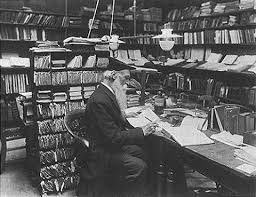
James Murray, primary editor of the Oxford English Dictionary

between its various Latinate roots and its related cousins in other languages, somewhere in its ancestry it means “neither” — as in, neither gender — and it’s also descended from the word “also” — as in, this gender and that one.

So neuter is neither gender AND both genders.  At the same time.  Come on, that’s just cool.  It’s like a whole poem or mini-essay, sparking the mind to all kinds of possibilities.  In just one word and its family tree.

I’ve always been a word nerd.  When I was bored as a kid, I spent a lot of time with the Almanac of Words at Play, a book of erudite word games for adults, the kind of thing two literary types had on their shelves for their kids to find.

I’m coming out of the nerd closet.  One of the greatest things about passing 50 is I have little left to prove and time to indulge my passions.  Two hours with horses this morning and quality dictionary time in the late afternoon, what could be better?


When Danny Colicked


20120512 Danny

Danny is a very difficult horse.  For reasons that could fill a book — and will, you can make advance reservations here for a book you can have read to you in 2056 in your hospice room — he long ago decided humans are either contemptible or dangerous, or both.  He’ll accept petting and cookies, but he’ll turn himself inside out to avoid school or work.

The other night, Danny colicked.  The word freezes the intestines of horse owners.  A simple gastric hitch — maybe a clump of food that didn’t process well, an excess of gas, a bit of inflammation — can kill an otherwise healthy horse.

I don’t know why horses are designed with such vulnerable digestive systems.  Horses can’t vomit.  They have a single, small stomach, unlike cows.  Their guts have to digest very tough, fibrous material, so they are extremely long and ropy, twisted into torturous coils in the back halves of their bodies.  With only one way for anything to travel, and a densely packed container, the slightest disruption can cause extreme pain.  Wikipedia lists 16 types of colic, including “other.”  Unresolved colics can kill, particularly when the gut ruptures from the stress.

The other night, I went to bring the horses in from the pasture.  Danny, for all his resistance to my leadership, is always first to come in from grazing.  Because I serve a smidgeon of grain at this time.  When I close the house door to head to the corral, he whinnies at me from wherever he is on the 25 acres.  He comes running to get his nose first into the grain.  The other two horses saunter in as and when they feel like it, sometimes requiring additional persuasion, but not Danny.

This night, Danny walked in slowly, second in line.  He took his place by his bucket.  I looked over all three to make sure all the body parts were where they belonged and headed back to the house.  As I was leaving the corral, I noticed that Danny was just standing over his bucket, not eating.  I paused.  He stood.  I turned to watch him.

His eyes were staring and locked.  To my horror, he turned and bit at his belly, a classic sign of colic.  Before I could move, he suddenly turned and charged aggressively at my older horse.  This was so uncharacteristic, I began to worry in earnest.  I grabbed a halter and collected Danny, taking him into my small training pen.  I began walking him around aimlessly as I’ve been taught.  He was vacant in the eye, stumbling a little as we walked.  We would stop and his knees would buckle a little — either he was thinking of rolling or just unsteady on his legs, both bad signs.  At one point, I let him loose in the pen to see what he would do and he started manically trotting around in small circles with no direction from me.

To make a long story tolerable, we spent an hour and a half together, waiting to see what would happen.  I gave him an anti-inflammatory drug.  I walked him.  I loaded him in and out of the trailer, I had him stand with just his hind feet in the trailer (downward facing pony pose) and then just his fronts.  I walked him some more.  His frightening behavior lessened.  When he seemed a little more with it, I moved him around in small circles, asking him to bend his body laterally.  He immediately started farting and didn’t stop for long minutes.  The relief floated up from him, along with the offending gas.  As we walked back to meet the other horses, he let out a distinct belch and looked satisfied with himself.

So all was well.  The real story happened the next day.  I went into the corral with a halter to catch my young horse for some schoolwork.  Usually, Danny avoids me.  With a turn of his head, a half-turn of the the body, a slow saunter, or a determined trot, he goes away when I come with a halter.  This day, he didn’t.  He stood looking at me.  I approached him as an experiment and, by god, he stepped towards me.  I pretended to catch him, just to make my point, and petted him vigorously all over, before going about my business with the other horse.  The next day, he did the same thing.  The third day, I stood with Danny while he got new shoes put on and he was as peaceful and affectionate as I’ve ever seen him.

We are warned not to anthropomorphize our horses, even while we spend all our time trying to understand their psyches.  Of course we can’t help but anthropomorphize them — we have only our anthropoid eyes to see them with and anthropoid brains to process the data.  Pretending to be objective about animals is like pretending we only have eyes to perceive a park and the sounds don’t matter.  However, we can do our best not to project ourselves onto them, trying our hardest to see them with all of our senses as they are and not as we want them to be.

Did Danny decide I could be trusted after all?  Was he grateful that I helped him?  Did he form a Pavlovian positive association between me and those blissful farts?  Did he sense that I wanted to help and was willing to stick with him until he was fit again and appreciate it?  I’ll never know what happened inside him, but I know how it looked — and felt — from the outside.
20120506 Danny Kate

Write to the question

Rebecca McClanahan: “I love nonfiction best because I love the world.”

Me, too.  The personal essay allows me to not only let my mind wander and dart where it will, but encourages those wanderings and dartings.  They are the very things that make a piece unique — only I can write this because only I had this bizarre series of free associations from a particular observation or experience.

Writing gives me the chance (excuse?) to investigate all the questions I can find, in a way I may not do otherwise.  Another paraphrased Rebecca-ism: if your writing doesn’t change you, it’s just a hobby.