How to Fix Your Horse Problems

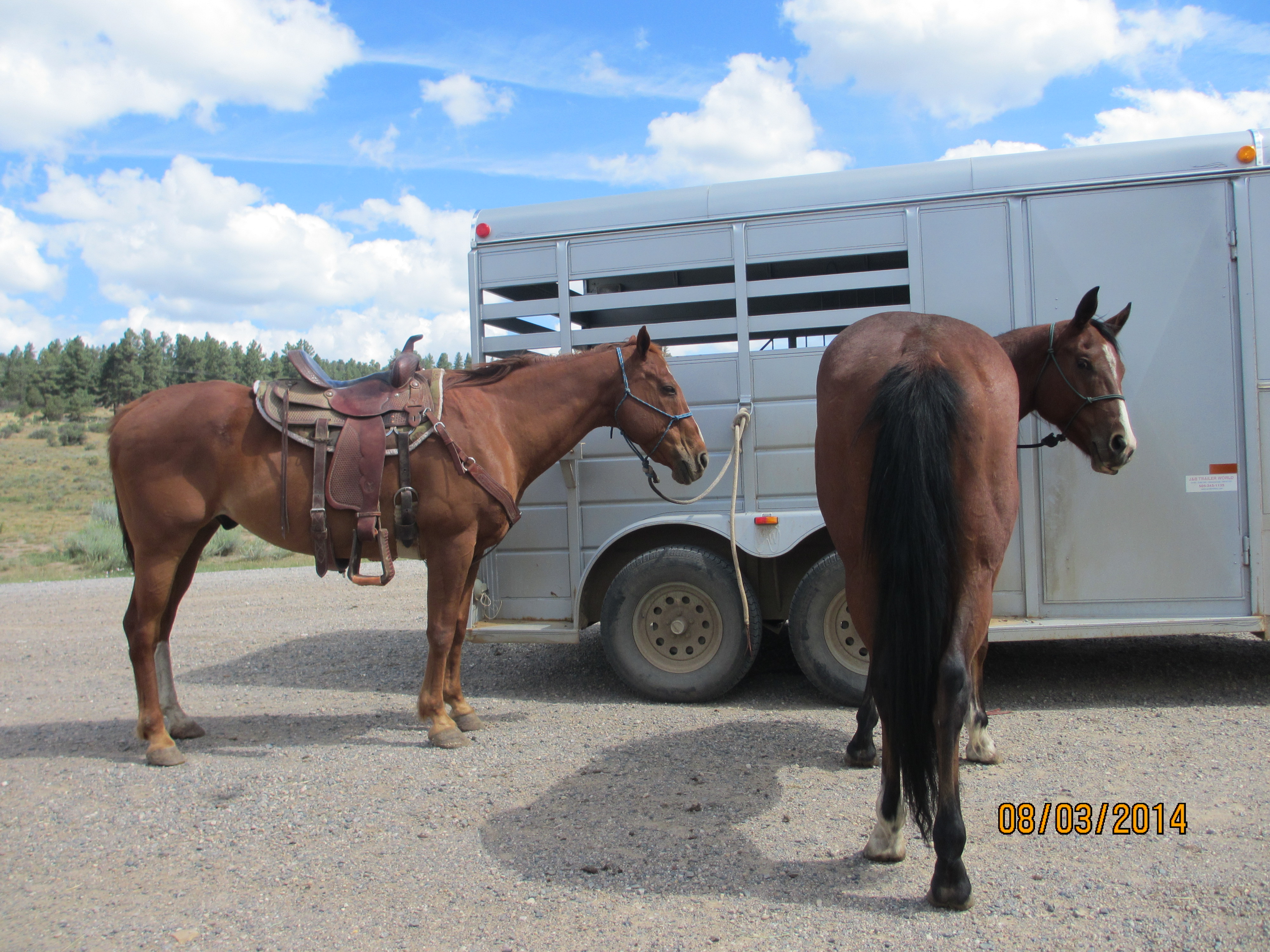
If he won’t get in the trailer, it might be because he’s worried about the shaky footing, or because he hated the last trailer ride he went on, or because he’s ignoring you, or because his friends are back in the paddock, or because you’re not being firm enough, or because you never taught him to mind you in the first place, or because you just don’t have what it takes. 

            If he wiggles while you saddle him, it might be because he’s uncomfortable with the cinch, or because there’s a sticker in the saddle blanket, or because he’s distracted by the dogs over there, or because he’s bored, or because his back hurts, or because he doesn’t respect you, or because you just can’t get there with him. 

            If he won’t pick up the canter, it might be because he’s out of balance in his hind end, or because he’s too heavy on his front end, or because he’s lazy, or because you haven’t got his attention, or because you’re out of position, or because your legs say go but your seat says stay, or because you really don’t belong here.

            You can fix it by doing more by doing less, or by being his leader while being his friend, or by moving faster without rushing, or by moving slower without dawdling, or by driving him into a stop, or by working him harder without drilling him, or by finding and filling in all the secret holes in your character.

            And you can fix it by being sure, being flexible, being confident, being relaxed, being fair, being firm, being brave, being humble, being bigger than you are, being smaller than you are, being what you always wanted to be and never were.

            Just don’t be emotional, don’t be cold, don’t wait too long, don’t come in too soon, don’t chicken out, don’t push too hard, don’t nag at him, don’t coddle him, don’t think too much, don’t forget, don’t rush him, don’t get sucked into the existential chasm in the corner. 

You’ll know you’ve got it when he’s content and willing and snappy and relaxed and bright and forward and balanced. 

You’ll know it’s good when you’re in harmony, in synch, partners in a dance. 

His legs will be as your legs, your bodies will move as one. 

And the nights will pass quicker and the shadows in the corners will grow quiet.

You’ll know.
Seven things I know about horses

Range

After we moved to the woods, we unpacked musty dreams from the bottoms of trunks. 

Perspective

When I met him, my first horse Jack lived at someone else’s place.  To the owner, sipping rare tequila on his gazebo, it was the set of Dallas; to me, poking around in my earliest horse capers, it was the OK Corral; to Jack, at the bottom of the herd hierarchy in the dusty yard, it was a low-rent apartment.

Compassion

The horse can feel a fly land on him in a windstorm.  Once I put someone else’s saddle on Jack.  He was reluctant to move but I made him.  Part-way through our ride, he gave an all-over shudder like a wet dog.  When I took the saddle off, we ran fingers along his spine and he flinched, scooping his belly toward the ground.  I felt like a traitor.

Acceptance

I bought a little colt, just weaned from his mother. He immediately tried to nurse on Jack.  Jack’s eyes bugged out, but he let the baby hunt.

Leadership

Jack and I were collecting cattle from open country.  We got separated from the other riders and horses.  Jack did not believe I had control of the situation, so he called and called, sending to the 360-degree horizon for a better companion. 

Trust

Jack had a few owners before me.  One rejected him at age three.  One rode him once a year for three years.  Jack fled from his last owner so hard he broke his own halter rope and went tumbling over backwards.  Jack showed the vet the whites of his eyes.  I rode Jack for thirteen years, in arenas, on trails, through obstacle courses, to round up cattle.  Jack was very selective in his friends, but he let me scratch him between his ears.

Generosity

I fell off my young colt and broke my arm. For the first time, I had fear with the horses. Choking fear, nauseous fear. Seeing people riding horses on TV made my throat close up. I crept over to Jack in the dawn before work, crawled on his gentle old back, and rode him one-armed at a walk through the high grass. He gave me no guff and ignored my tears.

Heartbreak

Jack died. I nursed him into his old age, bringing him hot mash every night to bank against his skinny frame. But he died in blood and foam and seizure. We don’t know why, but somehow his skull was pierced in the night. The vet, not my usual beloved vet who just had to be away, said “You can shoot him or I can euthanize him.” After the injection, I cut his tail and had a bracelet made of his hair.       

Good horse, good truck

Last week we had to evacuate because of a wildfire less than a mile from our property. I’ve played out — and dreaded — this scenario in my mind dozens of times and now it had arrived. But it was not as I had imagined before — now I had cows.

I was alone at the time. Dozens of channels in my mind alerted at once. The animals! Paperwork and keepsakes in the house! Where will we go? The animals! How long do I have? The livestock trailers! The animals!

I hooked up our good truck to my big horse trailer. I collected my horses from where they were grazing at pasture. All the time I was panicking about everything I was not doing.

I went to hook up our beat up old farm truck to my smaller, older horse trailer, but found I had been softened and weakened by the advent of backup cameras. In my increasing panic and with lack of practice, I could not connect the old truck to the old trailer without another set of eyes. Luckily, my neighbor was able to come help guide me in.

Then she helped me load the cows in the smaller trailer. Cows are not like horses; they are somewhat trained to lead with a halter, but only somewhat. And they are not accustomed to trailer rides. With a great deal of encouragement, we got mama and the two calves into the trailer and closed the door.

Next we caught the chickens. One by one we accosted them, as they grew more panicked at each of our tries. Somehow we got them all and shoved them in our old, plastic dog kennel and got the kennel hefted into the back of the truck.

Compared to the rest, loading my horses into their trailer was a dream. They were used to the procedure and cooperated smoothly.

I ran to the house and collected our box of legal papers, some underwear and socks, my expensive guitar, my dog’s bed. I snatched semi-randomly at whatever I could.

Finally, my husband arrived home. The dog and I drove off in one truck and trailer and he followed in the other. We headed to a friend’s place who offered shelter for the entire menagerie.

The fire never grew and was quickly contained. Our property was not touched. We reversed ourselves and got everyone back home the following morning.

Yesterday, when I brought the cow and horses in from grazing at pasture, the two calves were nowhere to be found. Mama called for them. I hiked a circuit where they should have been. Nothing. Mama kept calling. This was a scenario I had never pictured.

My first instinct was to saddle my horse and ride out with my lasso rope to find them. That would be the right and normal instinct if you were a cowboy. I’m not. I’ve flirted with cowboyism but never claimed to achieve it. Yet, I had a horse I could rely on, a lasso rope I could do something with, and confidence that together we could do what we needed to do.

In this case, the calves showed up before I could get saddled up, bawling at the gate to get back to mom. I patted my horse on the shoulder, infinitely grateful for what I knew he could have done for us.

It’s one thing to collect some livestock and make friends with them. It’s another to be prepared for the unexpected. That’s the rule of livestock, the unexpected. You can’t foresee every eventuality. You can’t practice all the things that will happen. All you can do is gain general skills and reliable equipment. Build good and mutually helpful relationships. Flirt with and practice whatever comes your way. I never know what I will need my truck or my horse to do, but I rest easier knowing that they will probably be up for it.

The Horse’s Eye


IMG_0114


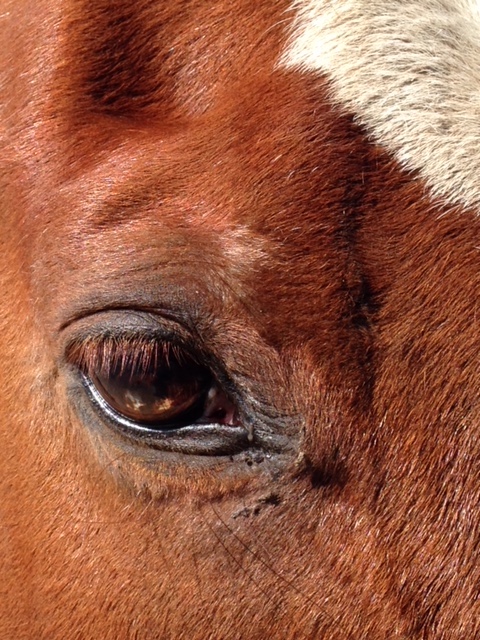
It is awful to be seen by a horse.

[awful: creating a sensation of awe]

You’ll see, if you care to look,

how he knows everything that matters.

Your weakness, your hope,

Your fear and self-deception,

Your intentions, or lack thereof.

He turns his head, knowing all.

And you know so little,

of him,

of yourself.

“Stay with him and wait”

img_0806-crop

Bridger was nervous in the arena.  He was worried about the trash cans outside the fence, where black cats once popped out right under his nose like Halloween Jack-in-the-boxes.  He was skeptical about the safety of the dais at one end where judges looked down on the proceedings.  And he was seriously concerned about the staffer hosing down the alleyway next to the arena.  The shadowy figure, the hiss of the water, the spray and fleeing dust were dreadful to the young horse.

I rode him through our lesson, round and round and across the arena, urging him closer and closer to the worrisome spots while trying not to push him to panic stage.

We were working on some small circling maneuvers near the hose man.  I was keeping Bridger’s attention focused on a minute task in the presence of something scary, trying to take his mind off the threat.  Someday, hopefully, Bridger will look to me in these cases and take my lead on whether there is danger, but we’re not there yet.  He complied with my directions, but stayed alert to the dangerous situation next to us.

Suddenly, Bridger tucked his enormous haunches under himself and launched forward and sideways.  He worked so hard at his instantaneous spook that he let out a huge fart as he went.

My brain lags at these moments — it took me a few milliseconds to realize what was happening.  By the time I processed it, we had jumped halfway across the arena and he was trotting out the end of his spook.  I was securely in the middle of the saddle, hardly a hair out of place.

Here’s what I loved about this.  I was not afraid.  I sat deeply in the saddle and held on to the gullet.  When he was back on four feet, I calmly gathered the reins to prepare to slow him down or simply go on to the next thing.

As he launched into the air with his gaseous assist, my brain spoke very clearly: “stay with him and wait.”  I wasn’t sure what he was doing but I had learned not to panic.  I knew I needed to keep my balance and stay on the horse and that the moment would pass. I learned this the hard way.

Last summer, when Bridger gave out a much less impressive quasi-buck, my brain told me something else: “holy shit! disaster! abandon ship!”  So I did.  I thought his minor upheaval was the beginning of mayhem without end, and I fled.  And got a broken bone and several lasting bruises for my choice.

After months and months of dedicated effort, including a volume of tears and sweat, my instinctive brain was finally able to say something reasonable and helpful.  And correct.  Stay with him and wait.  So I did and all was well.

And now I go forth, hoping to do the same in whatever life throws at me.  Which looks to be quite a bit in the near future.  I hope to ride the upheavals as they go and wait for the moment when I can right the ship.  And keep my bones intact.


In Praise of Small Bites

cupcake

I’m a fan of the small-bites approach, to many things, but I suffer doubt whether it’s all that effective.  Our culture generally screams for the whole hog.  Go big or go home and that kind of thing.  Taking small, regular bites seems somehow weak, boring, un-American.  But now I’m convinced.

I used to go big most of the time.  Riding my bike up a steep section, I did it as fast as possible, both to conquer the challenge and to get the difficulty over with so I could rest on the downhill.  I cleaned the whole house in a flurry, and then did almost nothing for much too long.  I lived on an intensity-collapse cycle.  I got a lot of stuff done.

Then I started riding a young horse.  He freaked me out a couple of times with his power and independence.  When he was in a tough spot, going big was no longer an option.  Not for me.  If I bore down and pushed him through these things, he would likely have escalated further before we got through, and I was already past my limits.

On great advice, and with no other plan, I started on the small bite approach.  I worked with or rode him to the degree I could without going too far beyond my comfort zone.  That wasn’t very much at times.  Because it was emotionally so challenging, I couldn’t ride him for very long or do very much before I needed to regroup.  I noticed no change, my entire focus was getting out there and getting to that edge.

I was skeptical.  Small bites move slowly.  They are tedious.  Change is almost imperceptible.  Day after day, I still felt nervous, I still did small things.  The top of the hill stayed just out of sight.

The gradations of challenge with Bridger the colt go kind of like this: groundwork (unmounted) –> riding in the small round corral –> riding in the larger corral –> riding out on our 25-acre property –> riding out around the neighborhood.  At the start, I did 100% groundwork, and slowly started adding portions of the next steps.

Yesterday, I hardly did any groundwork, skipped the round pen, spent a few minutes riding in the corral and then spent most of the time on the road around the neighborhood.  I felt almost no nerves the entire time.  Suddenly, after all those tedious, tiny bites, change erupted.

I like small bites.  I clean my house a little bit every day (well, that’s the plan).  I tackle parts of chores and leave other parts for the next day.  I push quickly up the hill if I want my heart to beat faster, otherwise I stop and look around.  It really works.


The Om in Horsemanship


Om

It’s pouring down rain, so there won’t be much horsing around today.  My goal of riding Bridger every day as a cure for our woes is on pause this day.  But there’s plenty of time for thinking about horses and life and stuff.

Horseman Peter Campbell says something like “the problem is not the problem, your attitude about the problem is the problem.”

My “problem” with Bridger is very simple — there are things he needs to understand better and ideas he has that I’d rather he didn’t.  This wouldn’t be a problem at all except that the process of teaching and redirecting him can be scary because I sit on his back and he is large and powerful.

But even so, it’s my attitude that creates the problem.  When Bridger gets fractious or lost, there are a couple options.  If I were Buck Brannaman, I’d ride him right through it without blinking because I would know I could.  Or, I could see the issue developing, mindfully dismount and address it from the ground.  Neither is a problem.

What do I do?  Fear grabs me, or maybe frustration, and right behind come self-doubt, self-criticism, dismay and a bunch of other complicated emotions.  My muscles tighten, my mind trips offline.  I’m lost in a feeling storm, useless for giving my horse the direction and confidence he needs.  If I’m not careful, I can start blaming Bridger for the whole mess.  And voila — a real problem.

FDR would have answered Peter Campbell nicely, adding, for example, that all we have to fear is fear itself.  Or anger or jealousy or despair.  My yoga teachers would nod sagely — notice where your mind goes when your body is challenged, they say, is it necessary?

How many times a day do we create problems with our emotions and reactions where, in fact, there is simply a circumstance?

Yoga and horsemanship point me in the same direction: stick with exactly what is for a while and let the rest go.  Next time I get on Bridger’s back, I’ll be really trying to do just that.

This Horse Ain’t Broke

They used to call it breaking a horse.  Many still do.  Breaking his spirit, breaking his independence.  Taking something correct and complete and destroying it.  It’s fitting terminology for what it used to look like (and still does in some circles).

                 I was going to insert a video clip of a horse getting “broke” here but I just can’t do it, so here’s something cute instead:

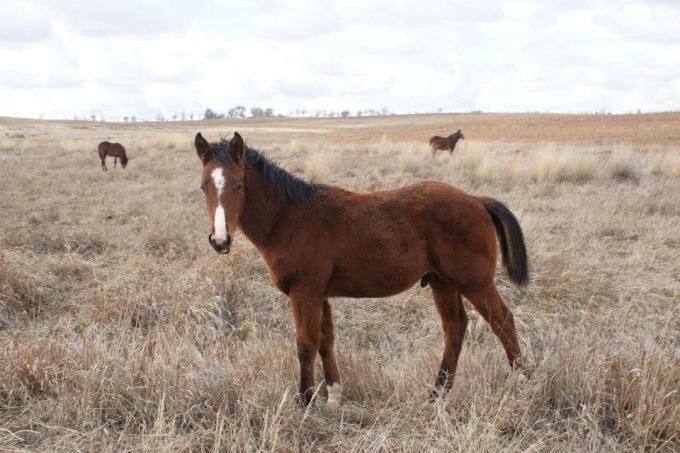
201110 baby
My colt Bridger at four months, correct and complete

I broke my arm once.  Just a little, hairline fracture.  It’s healed up now, but it will never be the same.  It can never be unbroken.

The horsemen I follow call it starting a horse.  Starting into a long education.

<Buck Brannaman explains how it’s supposed to be>

We ask the horse to consent to do what we ask.  We give him time and space to consider his options, and in the end, he usually agrees with our suggestions.  It’s a wondrous thing.

But what about when he doesn’t?  In his fifth year, Bridger suddenly started disagreeing.  Suddenly, that is, if one has failed to see the ripples and eddies forming on the surface of the pond.  Bridger has now decided to revolt against those things he doesn’t like.  The sweet, seemingly compliant kid has erupted into a surly teenager.

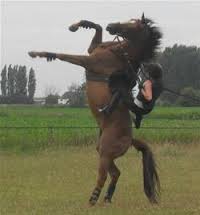
He’s a horse, surly is the wrong word.  He’s unconfident and worried and irritated and frustrated, by turns or all at once.  Maybe he wasn’t before, or maybe he just wasn’t showing it much.  Now he is.  His modus operandi is to rear up, which can be extremely dangerous.


rearing
This is not Bridger and me.  This horse is about to fall over backwards on that person, which could be the end for both of them.  I hope it wasn’t.

So now we have to convince Bridger to quit it.  We have to make him understand that his rearing idea — and his defiance ideas in general — won’t work out for him and he needs to find other ideas.

The plan, implemented by my teacher, Kathleen Sullivan, is to provoke the unwanted response and then show Bridger it’s not in his best interest.  If we pussyfoot around and avoid the tough spot, it will stay in there and solidify.

“If it is repressed and isolated from consciousness, it never gets corrected.”  Carl Jung.

Here’s the thing: correcting a problem can look awfully like breaking something.  Kathleen gets pretty vigorous with Bridger when he thinks about rearing up.  In my work with him, it can be the same.  Dust flies, there is sweat.  First he is quick and powerful and troubled, then, soon, he is docile.

I have to find the difference because I know we are not breaking him and won’t break him and can’t break him.  Right?

Here’s the best I can do so far:

  • Breaking: you reach for my french fries and I punch you in the face.  I have my fries and you resent and fear me.  Someday you may punch me back, if I ever see you again.
  • Correcting: you reach for my french fries and I block your hand; you reach harder and I block harder; I block as fast and hard as I need to in protecting my fries; our hands fly like a Three Stooges routine; you give up trying.  I have my fries and you recognize you won’t get any by grabbing.  Maybe you ask politely and I give you some.  Maybe you order your own.  We’re friends.

Sometimes I use the shorthand term “broke” because horse people understand it.  I tell people Bridger’s “broke to tie” or “green broke.”  I hope beyond hope I haven’t broken anything much.  It’s not the plan.


On not being a natural

How you know when something comes naturally:

  • You feel relaxed and comfortable in it
  • You succeed without trying very hard
  • Your mind, or your body, accommodates itself instantly to the thing
  • The first time feels familiar
  • Something opens doors and propels you along
  • You move more easily and more quickly through it than other people
  • You can’t explain how or why you get it, you just get it

I have a few of those.  I presume everyone does.

Horsemanship is not one of them.  I thought I was reasonably coordinated, fairly strong, adequately brave, thoroughly sensitive and exhaustively honest with myself.  Working with horses puts the lie to all that.  The myriad aspects of this art do not come naturally and destroy my self-concept.  After 10 years of diligent study with an excellent teacher, I:

  • Fumble and flail with the gear
  • Use my hands in the wrong way
  • Place myself in the wrong position
  • Read the horse wrong
  • Make the wrong choices
  • Increasingly quail from the size of the job
  • Fear more
  • Misunderstand my own demeanor

I finally get it that I’m not a natural.  Maybe I’m reaching acceptance, having moved through denial (“I’m awesome, this is great!”), anger (“what the hell is with this stupid horse?!?!”), bargaining (“horse, please, please just understand what I’m trying to say” or “teacher, please do this for me”) and depression (“—-“).

It feels bad.  I vastly prefer succeeding without effort, sailing ahead just because.  I’m embarrassed and ashamed and resentful that I’m only creeping and crawling forward, much more slowly than others.  I’m repulsed by my awkward moves and failed attempts.

But I’m still working at it.  It’s a miracle that I haven’t fled, but here I am.  I keep learning things, I succeed a little now and then.  And yesterday I had quite a breakthrough — I was actually amused at my own incompetence.  Later that afternoon, I was more comfortable in my own skin than I had been in a very long time.

Maybe this is the point.  The satisfaction might be in the job well done, but it also might be in getting comfortable with exactly where you are.  Natural or not.

IMG_0771